Date: 17-8-2026
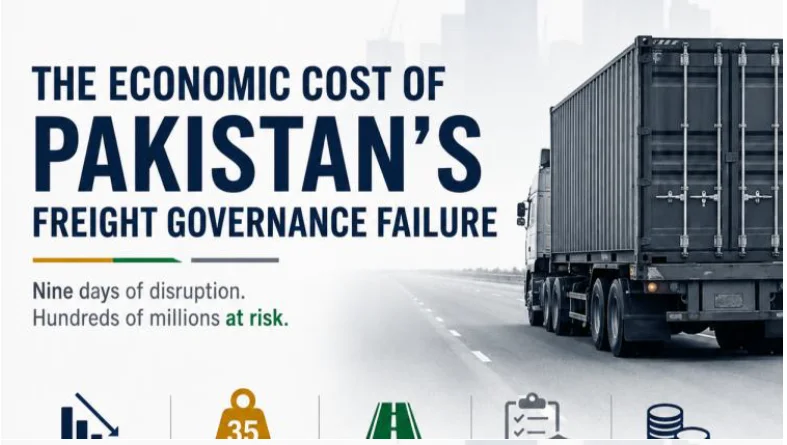
Pakistan’s nine-day goods transport disruption exposed a structural economic risk: the country depends heavily on road freight, but does not govern freight as critical national economic infrastructure.
The subsequent 22-point government–transporters agreement addresses legitimate operational grievances, but also creates potential fiscal, infrastructure and regulatory costs that require economic assessment.
The central issue is not who won the negotiations. It is who ultimately bears the cost of the concessions.
1. Nine Days Put Substantial Trade Flows at Risk
Pakistan’s FY2025-26 merchandise exports were approximately US$30.14 billion, equivalent to an average:
US$82.6 million per day.
Nine days therefore represented approximately:
US$743 million of normal export flow exposed to disruption.
This is not a claim of US$743 million in permanently lost exports. Delayed shipments may subsequently be recovered.
The economic loss arises through:
missed vessels + demurrage + detention + production interruptions + delayed inputs + inventory financing + contractual penalties + perishable losses + cancelled orders.
Industry estimates placed direct economic losses from the disruption above Rs50 billion. The final national cost should be established from Customs, port, industrial-production and transport data rather than industry estimates alone.
The more important finding is systemic: nine days of road-freight disruption were sufficient to place hundreds of millions of dollars of trade flows under operational risk.
2. Pakistan Has a Freight Concentration Risk
Pakistan’s three principal ports handled approximately 78.45 million tonnes during July-March FY2026, while Pakistan Railways carried approximately 4.84 billion tonne-km of freight over the same period.
Road transport consequently remains indispensable for port evacuation, industrial supply, agricultural distribution and domestic and international trade.
This creates a national economic concentration risk.
When road freight stops, Pakistan currently lacks sufficient alternative freight capacity to maintain normal economic flows.
The government’s negotiating position was therefore structurally constrained: the economic cost of continuing the disruption rapidly exceeded the cost of compromise.
3. The 35-Tonne Concession Creates an Infrastructure Externality
The agreement permits 35 tonnes for 10-wheelers for two years on National Highways and GT Roads, against a commonly referenced three-axle gross-weight benchmark of approximately 27.5 tonnes, depending on configuration.
That represents:
+7.5 tonnes | +27.3% gross weight
The economic benefit is immediate:
higher cargo per vehicle → lower freight cost per tonne.
The infrastructure cost is deferred.
Road damage increases disproportionately with axle loading. Using the conventional fourth-power relationship purely as an engineering sensitivity:
(35 ÷ 27.5)⁴ ≈ 2.62
If axle loads increased proportionately, the pavement-loading effect could therefore be approximately 2.6 times the reference movement.
This is not an estimate of actual national road damage; axle configuration and pavement characteristics matter substantially.
It nevertheless raises a critical policy question:
What is the incremental annual pavement-consumption cost of the 35-tonne regime?
Without this calculation, the freight efficiency gain cannot be properly evaluated against its public infrastructure cost.
4. Cheaper Freight Can Become More Expensive for the Economy
Pakistan has approximately 14,480 km of NHA network and allocated about Rs226.98 billion to 71 NHA projects under the FY2025-26 development programme.
The economics of excessive loading are therefore material.
If operators increase revenue by carrying more cargo while accelerated road deterioration is financed through NHA expenditure, taxation, tolls or public borrowing, the cost has not been eliminated.
It has been reallocated:
Private freight savings → Public infrastructure costs
This is a classic economic externality.
Pakistan should therefore evaluate logistics performance using:
Total Economic Logistics Cost
rather than:
Freight Rate per Tonne
A lower freight rate achieved through faster road degradation does not necessarily represent improved national logistics efficiency.
5. The Present System Also Penalises Investment
A modern multi-axle tractor-trailer requires significantly higher capital investment to distribute cargo weight safely.
If lower-standard vehicles achieve similar payload economics through higher axle loading, the regulatory framework creates a structural disadvantage for operators investing in compliant, higher-quality fleets.
The result is:
overloading → lower capital requirements → distorted competition → reduced fleet modernisation
This has implications for productivity, fuel efficiency, road safety, and long-term investment in Pakistan’s trucking sector.
Uniform axle-load enforcement therefore protects both public infrastructure and private capital formation.
6. Enforcement Should Begin With the Cargo Generator
The agreement’s emphasis on axle-load enforcement “from source” is economically sound.
Overloading is not created at highway weigh stations. It originates at:
factories, mines, ports, warehouses, terminals, and commodity loading points.
Pakistan should introduce joint consignor–carrier liability, supported by digital weighbridge verification and electronic freight documentation.
This realigns incentives.
A cargo owner seeking lower transport costs would no longer be able to externalise infrastructure damage entirely onto transporters and the public road network.
7. Customs Concessions Also Carry Economic Costs
The agreement seeks relief regarding vehicles carrying smuggled or non-custom-paid goods.
FBR reported that the Supreme Court’s relevant Customs ruling affected more than 1,000 confiscated vehicles, with projected auction proceeds exceeding Rs8 billion.
There is a legitimate economic argument for protecting carriers who are unaware of illicit consignments.
However, broad weakening of confiscation mechanisms would shift risk to:
government revenue + compliant importers + legitimate transporters
The economically efficient approach is an Innocent Carrier Defence based on verified consignor identity, electronic documentation, and demonstrable due diligence—rather than blanket exemptions.
8. Insurance Costs Cannot Simply Be Removed
Third-party insurance illustrates the same principle.
Insurance is a private operating cost, but road accidents generate social costs regardless of insurance coverage.
Sindh’s 2026 framework provides no-fault compensation of up to Rs700,000 for death and Rs500,000 for permanent disability.
Weakening compulsory insurance does not eliminate accident costs.
It redistributes them from:
vehicle operator/insurer → victims’ families/public systems
Policy should improve insurance efficiency, not externalise liability.
9. The Rs50 Billion Question Reveals a Data Gap
Industry estimates place losses from the nine-day disruption above Rs50 billion.
Pakistan should be able to independently verify this figure.
A credible assessment requires integration of:
Customs data + port gate movements + truck flows + railway freight + industrial output + demurrage/detention + export cancellations + commodity pricing
The absence of a unified national freight database meant that a major economic disruption was negotiated without a real-time estimate of its cost.
This represents a significant governance limitation.
The Policy Requirement
Pakistan must transition from transport regulation to freight economics.
TFN recommends five immediate measures:
- Independent economic and engineering assessment of the 35-tonne concession, including ESAL and annual road-maintenance impacts.
- Axle-load enforcement at cargo origin, supported by joint consignor–carrier liability.
- Establishment of a National Freight Observatory integrating road, rail, port, Customs, axle-load, and trade-flow data.
- Protection of investment in compliant multi-axle fleets through consistent national enforcement.
- Development of a National Freight Contingency Framework to reduce economic dependence on uninterrupted road transport.
Conclusion
The nine-day disruption demonstrated that Pakistan’s transport challenge is fundamentally an economic governance issue.
Approximately US$743 million of normal export flow was exposed during nine days. Industry estimates place immediate economic losses above Rs50 billion. At the same time, the government is investing approximately Rs227 billion in NHA projects, while agreeing to a freight-weight concession whose full infrastructure cost has not been publicly quantified.
These figures must be assessed together.
A freight concession is economically justified only when its benefits exceed its total national cost.
If lower freight rates accelerate infrastructure deterioration, discourage investment in modern fleets, increase accident liabilities, or weaken trade compliance systems, the apparent savings do not represent efficiency.
They represent a transfer of cost from freight transactions to the wider economy.
Pakistan must therefore move beyond measuring transport policy by the cost of moving a truck.
It must measure the total economic cost of moving freight.
Trade Facilitation Network (TFN) Connecting Regions. Enabling Trade.