Date: 8-1-2026
In a recent engagement with the Government, a very practical issue was placed on the table.
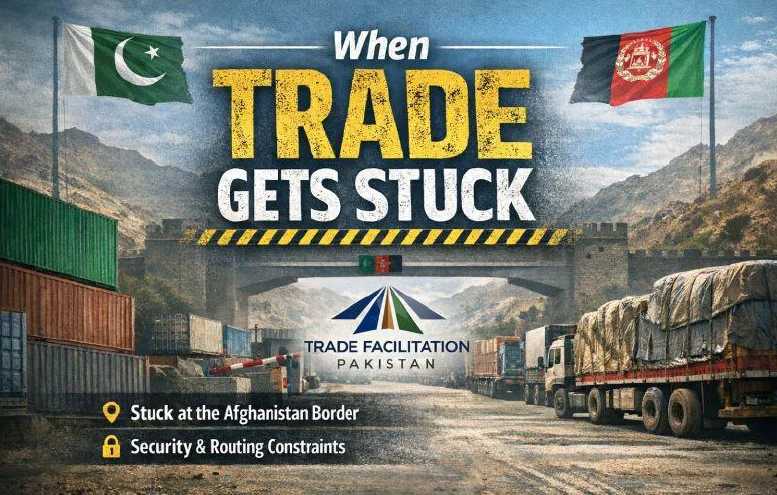
Large volumes of Pakistani export cargo remain stuck at or near the Afghanistan border due to security and routing constraints. The Government expressed its intent to support exporters, avoid disruption, and prevent losses — without crossing compliance or banking red lines.
Exporters were asked a straightforward question:
Can the cargo be diverted to alternative global markets?
The response was equally clear.
Yes, diversion is possible — but at a cost.
The Exporters’ Reality
Exporters explained that diverting cargo to alternative routes would increase transportation costs by up to 13 percent, depending on destination and modality. In addition, banks would not issue Financial Instruments (FI) for certain routings due to compliance sensitivities, complicating normal trade execution.
In short:
• Cargo can move
But it becomes slower, costlier, and more complex
• And the financial ecosystem does not automatically adjust
This placed the discussion where it needed to be — on practical trade-offs, not abstract solutions.
A Candid Policy Moment
At this point, the Secretary Commerce asked a rare and important question:
“Let us know what you want.”
Two options were on the table:
- A letter to the State Bank of Pakistan (SBP)
- Government support to absorb part of the additional freight cost
This moment reflected policy realism.
• Why Freight Support Becomes the Practical Choice
• Letters alone cannot compel banks to assume sanctions or correspondent risk.
• Compliance decisions are driven by international exposure, not domestic intent.
Freight cost support, by contrast:
• Acknowledges that diversion is forced, not commercial
• Compensates for abnormal logistics costs
• Allows cargo to move without altering banking or compliance frameworks
In crisis conditions, this becomes the least-bad, most implementable option.
A Strategic Caution
Freight support solves an immediate problem, but carries an unintended consequence.
If used in isolation, it may gradually push exporters away from Afghanistan and Central Asia, weakening Pakistan’s role as a regional supply and grading partner. This is not an argument against freight support — it is a reminder that emergency tools shape long-term behavior.
The Way Forward
Emergency freight support should be seen as:
• A crisis-response measure to clear stuck cargo
• A bridge to keep exporters operational
At the same time, policy language and administration must ensure that regional trade continuity is not unintentionally deprioritized once conditions normalize.
• Trade policy under constraint is rarely about perfect solutions.
• It is about limiting damage while keeping future space open.
The Government’s willingness to listen — and to ask exporters directly what is workable — is a positive signal.
Muhammad Anwar
Chair
Trade Facilitation Pakistan (TFP)