Date: 13-8-2026
From the Middle Corridor to the Arabian Sea: Why Kazakhstan’s Transport Strategy Matters for Pakistan
TFN | Trade Facilitation Network Eurasian Connectivity & Transport Analysis | August 2026
Kazakhstan is making a compelling case for the economics of connectivity.
Despite being the world’s largest landlocked country, it is undertaking substantial investments in railways, highways, Caspian ports, border terminals, logistics centres, and digital transport systems to position itself as a major Eurasian trade and transit hub.
An estimated US$35 billion has been invested in Kazakhstan’s transport infrastructure over the past seven years, with additional projects continuing to expand the country’s capacity across China, Central Asia, the Caspian Sea, and Europe.
This strategy carries an important lesson for Pakistan.
Kazakhstan is investing heavily to overcome the structural disadvantage of being landlocked.
Pakistan, by contrast, already possesses what Kazakhstan ultimately seeks: direct access to the Arabian Sea.
The state visit of Kazakhstan’s President Kassym-Jomart Tokayev to Pakistan in February 2026 therefore adds significant strategic relevance to Kazakhstan’s ongoing infrastructure expansion from Pakistan’s perspective.
Kazakhstan Is Building Corridors, Not Individual Projects
Kazakhstan’s approach is grounded in integration rather than isolated infrastructure development.
Its Concept for the Development of Transport and Logistics Potential through 2030 aims to develop road, rail, maritime, and aviation infrastructure in parallel with cross-border logistics hubs, modernised transport fleets, and the removal of non-physical barriers to transit.
According to the OECD, Kazakhstan occupies a strategically important position, sharing a border with China while also maintaining Caspian Sea access through Aktau and Kuryk.
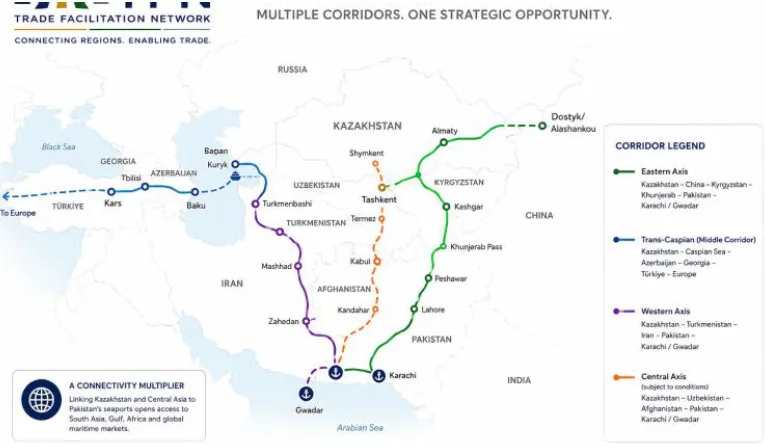
The Trans-Caspian International Transport Route—commonly referred to as the Middle Corridor—connects:
China → Kazakhstan → Caspian Sea → Azerbaijan → Georgia → Türkiye/Black Sea → Europe
Cargo volumes along this route have expanded rapidly as global shippers seek alternative and more resilient Eurasian supply chains.
OECD data indicates an increase from below 1.5 million tonnes in 2022 to over 3.3 million tonnes in 2024 on the China–Europe route via Kazakhstan and the Caspian system.
Kazakhstan’s broader transport strategy targets 74 million tonnes of transit traffic by 2030.
Importantly, infrastructure is being developed ahead of full demand realisation.
Rail: Building the Eurasian Backbone
Railway capacity is being expanded across multiple strategic corridors.
The Dostyk–Moiynty railway, linking the Chinese border with Kazakhstan’s national rail network, has undergone significant double-tracking and capacity enhancement.
Kazakhstan is also developing the approximately 300-km Bakhty–Ayagoz railway, establishing an additional rail gateway with China.
The Almaty railway bypass is designed to alleviate one of the country’s key freight bottlenecks.
Collectively, these initiatives reflect a core principle of corridor economics:
Infrastructure capacity must precede trade growth. Reliable freight systems cannot be built after demand materialises.
Roads: US$1.53 Billion for a Strategic Corridor Section
Kazakhstan is applying a similar logic to its highway network.
The Transport Resilience and Connectivity Enhancement (TRACE) project on the Jezkazgan–Karagandy section of the Middle Corridor is valued at approximately US$1.53 billion.
The World Bank and the Asian Infrastructure Investment Bank are each contributing US$650 million.
The project involves upgrading approximately 498 km of highway from Category III to a Category I dual carriageway.
Notably, the programme extends beyond physical roadworks and includes:
• climate-resilient engineering design
• road safety systems
• electronic tolling infrastructure
• electric vehicle charging facilities
• axle-load management systems
• improved rural connectivity
• performance-based construction and maintenance frameworks
Kazakhstan is therefore treating highways as commercial logistics infrastructure, rather than conventional public roads.
Aktau and Kuryk: The Caspian Maritime Link
The ports of Aktau and Kuryk constitute the maritime component of the Middle Corridor.
Kazakhstan has been expanding container handling capacity, terminal infrastructure, and port logistics systems to facilitate freight movement across the Caspian Sea towards Azerbaijan and onward through Georgia and Türkiye.
The EBRD and the European Union have supported further development of Aktau’s container facilities.
This enables a fully integrated multimodal chain:
China → Rail → Kazakhstan → Aktau/Kuryk → Caspian Sea → Azerbaijan → Georgia/Türkiye → Europe
Kazakhstan’s success is therefore not based on a single railway or port, but on the integration of:
Rail + Road + Ports + Border Terminals + Customs Systems + Digital Platforms + International Agreements
into a unified transport and logistics architecture.
February 2026: The Pakistan–Kazakhstan Relationship Enters a New Phase
Against this backdrop, President Kassym-Jomart Tokayev’s state visit to Pakistan on 3–4 February 2026 carries heightened significance.
It marked the first visit by a Kazakh president to Pakistan in approximately 23 years.
During the visit, both countries elevated their relationship to a Strategic Partnership through a Joint Declaration signed in Islamabad.
The visit resulted in a substantial set of governmental and commercial agreements. According to official Kazakh statements, more than 70 agreements and memoranda of understanding, including commercial contracts, were concluded.
Key areas of cooperation include:
transit trade, customs cooperation, transport and logistics, financial regulation, agriculture, investment, mining, energy, maritime affairs, education, healthcare, and security cooperation.
Both sides also agreed to establish a biennial Strategic Dialogue at the Deputy Prime Minister/Foreign Minister level.
This institutionalises the relationship beyond diplomatic engagement and provides a structured framework for sustained economic cooperation.
The US$1 Billion Trade Target
The economic ambition of the relationship is equally significant.
According to Kazakh data reported after the visit, bilateral trade reached approximately US$105.6 million in 2025, nearly double the previous year’s level.
However, both countries acknowledged that this figure remains well below potential.
As a result, they set a target of increasing bilateral trade to approximately:
US$1 BILLION
President Tokayev also encouraged Pakistani enterprises to establish production facilities in Kazakhstan, particularly in agro-processing, pharmaceuticals, and construction materials.
Commercial agreements worth approximately US$200 million were also announced during the Pakistan–Kazakhstan Business Forum.
However, a near tenfold increase in trade cannot be achieved through diplomatic intent alone.
It requires a robust logistics system capable of physically enabling that level of exchange.
The Most Significant Signal: Access to Pakistan’s Ports
This is where Kazakhstan’s transport strategy directly intersects with Pakistan’s geography.
Transport and logistics were identified as priority areas during discussions in Islamabad.
President Tokayev specifically highlighted the potential use of:
Karachi and Gwadar
as gateways for Central Asian trade.
For Kazakhstan, this represents a strategically important development.
Its Middle Corridor primarily provides an east–west axis:
China ↔ Kazakhstan ↔ Caspian Sea ↔ Europe
Pakistan introduces a complementary dimension:
North–South connectivity to the Arabian Sea.
Rather than competing with the Middle Corridor, this linkage would enhance and diversify it.
Kazakhstan Requires More Than a Single Corridor
Kazakhstan’s geographic position naturally supports multi-vector connectivity.
Western routes extend through the Caspian towards Europe.
Eastern routes connect directly with China.
Northern infrastructure links into Russia.
However, long-term trade resilience also requires efficient access to the Indian Ocean and Arabian Sea.
Pakistan offers a potential southern maritime gateway.
Several corridor options merit commercial consideration:
Eastern Axis
Kazakhstan → Kyrgyzstan → China → Khunjerab → Pakistan → Karachi/Gwadar
Western Axis
Kazakhstan → Turkmenistan → Iran → Pakistan → Karachi/Gwadar
Central Axis
Subject to political and security conditions:
Kazakhstan → Uzbekistan → Afghanistan → Pakistan → Arabian Sea
Each route presents distinct economic, infrastructural, and geopolitical considerations.
Collectively, they highlight the structural complementarity between Pakistan and Kazakhstan.
Pakistan Should Not View Kazakhstan Solely as a Bilateral Market
A key policy implication emerges from this evolving relationship.
Pakistan should not approach Kazakhstan merely as an export destination.
Kazakhstan is actively developing itself into a Eurasian logistics platform.
Effective integration with Kazakhstan therefore provides access beyond its domestic market to:
Central Asia → China → Caspian region → Caucasus → Türkiye → Europe
Conversely, Pakistan offers Kazakhstan and neighbouring Central Asian economies access to:
Karachi → Port Qasim → Gwadar → Gulf → Africa → South Asia → global maritime routes
The opportunity is therefore not limited to bilateral trade expansion.
It is fundamentally about linking Eurasian land corridors with Arabian Sea maritime networks.
Infrastructure Alone Is Not Sufficient
Kazakhstan’s experience also highlights an important lesson for Pakistan.
International freight does not select routes solely on the basis of physical infrastructure.
It is determined by:
cost, time, reliability, security, and regulatory predictability.
Accordingly, Pakistan must develop more than physical connectivity between ports and northern borders.
A commercially viable Pakistan–Central Asia corridor requires:
• predictable transit and customs regulations
• internationally recognised transport documentation
• harmonised customs procedures
• digital cargo tracking and visibility systems
• through-bill and multimodal documentation frameworks
• modernised vehicle and trailer standards
• effective axle-load enforcement mechanisms
• cargo and carrier liability systems
• simplified visa regimes for transport operators
• cross-border insurance arrangements
• secure and efficient logistics terminals
• streamlined border infrastructure
• competitive rail and road freight services
Without these elements, geographic advantage remains latent rather than operational connectivity.
From the Middle Corridor to a Broader Eurasian Network
The emerging opportunity extends beyond individual corridors.
Kazakhstan is strengthening the:
China–Europe Middle Corridor
Pakistan has the potential to develop a complementary:
Central Asia–Arabian Sea Corridor
Together, these could form a broader integrated network:
EUROPE
↕
CAUCASUS / CASPIAN
↕
KAZAKHSTAN
↔ CHINA ↕
CENTRAL ASIA
↕
PAKISTAN
↕
KARACHI • PORT QASIM • GWADAR
↕
ARABIAN SEA
↙ ↓ ↘ GULF • AFRICA • SOUTH ASIA
This configuration reflects Pakistan’s potential role as a critical maritime gateway within a wider Eurasian logistics system.
TFN Perspective
Kazakhstan’s transport transformation offers a clear strategic lesson.
Geography creates opportunity. Infrastructure creates capacity. Facilitation creates trade.
Kazakhstan is investing heavily to convert its geographic position into a functioning international logistics system.
Pakistan already possesses strong geographic advantages: access to the Arabian Sea, proximity to Central Asia, a border with China, connectivity with Iran, and access to major global maritime routes.
President Tokayev’s February 2026 visit has also established an important political and institutional foundation for deeper Pakistan–Kazakhstan connectivity.
The resulting agreements on strategic partnership, transit trade, customs cooperation, and transport connectivity, along with Kazakhstan’s interest in Karachi and Gwadar, should be developed beyond diplomatic statements.
They should form the basis of a structured Pakistan–Kazakhstan Transport and Transit Corridor Programme.
The objective should extend beyond increasing bilateral trade from approximately US$100 million to US$1 billion.
The broader strategic goal should be to connect:
Kazakhstan’s Eurasian land network with Pakistan’s Arabian Sea gateways.
Kazakhstan is demonstrating how a landlocked country can invest to become a logistics hub.
Pakistan’s challenge is different.
Pakistan already has the geography. It now requires the regulatory, infrastructural, and institutional systems that ensure global trade consistently chooses that geography.
Trade Facilitation Network (TFN) Connecting Regions. Enabling Trade.
Trade Facilitation | Multimodal Transport | Eurasian Connectivity | Regional Corridors | Policy & Research