Date: 11-8-2026
At a time when Russia and India are seeking stronger and more resilient transport connectivity, Eurasia may not need another entirely new railway corridor.
It may need to reopen one railway gate.
Khokhrapar–Munabao.
Situated on the Pakistan–India border, this railway crossing is normally viewed through the narrow lens of bilateral relations between Islamabad and New Delhi. That perspective understates its potential strategic importance.
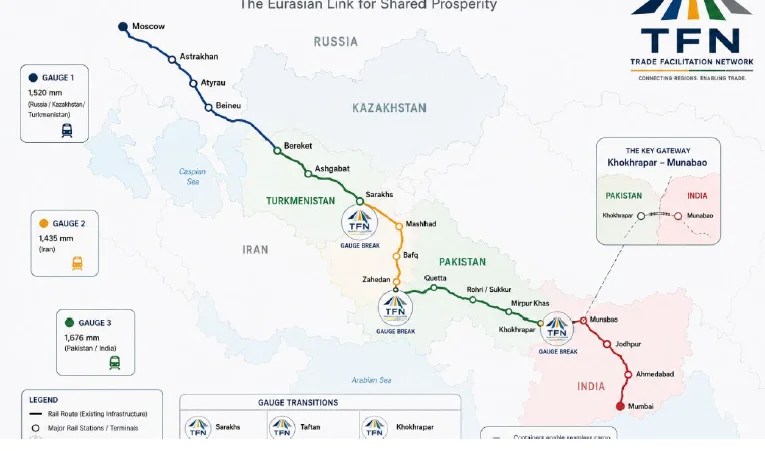
Look at the railway map from Moscow instead.
A continental rail chain can conceptually be traced:
Moscow → Astrakhan → Atyrau → Beineu → Bereket → Ashgabat → Sarakhs → Mashhad → Bafq → Zahedan → Taftan → Quetta → Rohri/Sukkur → Mirpur Khas → Khokhrapar → Munabao → Jodhpur → Ahmedabad → Mumbai
The railway infrastructure across much of this geography already exists.
What does not exist is a continuously operational international freight corridor.
And at the southern end of this enormous Eurasian chain, Khokhrapar–Munabao becomes the critical gateway.
A Border Crossing — or a Continental Gateway?
Khokhrapar in Pakistan and Munabao in India have historically provided rail connectivity across the international border.
• Today, however, the crossing does not function as a normal international freight corridor.
• That fact is usually treated as a Pakistan–India issue.
• It should also be examined as a Eurasian connectivity issue.
If international container traffic could move from Russia through Kazakhstan, Turkmenistan, Iran and Pakistan, Khokhrapar–Munabao could provide the onward railway connection into India’s extensive rail network.
From Munabao, cargo could move toward Jodhpur, Ahmedabad and ultimately Mumbai.
This transforms the strategic meaning of the crossing.
Khokhrapar–Munabao would no longer represent simply a railway between two neighbouring countries.
It could become a gateway connecting Russia and Central Asia with the Indian subcontinent.
Russia Wants Connectivity with India
Russia has strong strategic and commercial reasons to diversify its transport connections with India.
The International North-South Transport Corridor already reflects this objective. But conventional north-south arrangements continue to depend substantially on multimodal combinations involving ports and maritime sectors.
An overland railway chain through Central Asia, Iran and Pakistan presents another possibility.
At the same time, Pakistan has demonstrated interest in establishing rail freight connectivity with Russia through Iran, Turkmenistan and Kazakhstan.
These two ambitions should not be considered separately.
Pakistan wants railway connectivity northward toward Russia. Russia wants stronger connectivity southward toward India.
Khokhrapar–Munabao is where those two strategic ambitions could eventually meet.
Pakistan Is Not the Destination. It Is the Bridge.
This changes Pakistan’s role fundamentally.
A Moscow–Pakistan railway should not necessarily terminate at Islamabad, Lahore or Karachi.
Pakistan’s railway geography allows the corridor to continue.
From the Iranian frontier at Taftan, the railway enters Pakistan through Quetta, proceeds toward the national railway network around Rohri/Sukkur, and can continue through Sindh toward Mirpur Khas and Khokhrapar.
Across the border lies Munabao and the Indian railway system.
Pakistan therefore possesses a geographical position that neither Russia, Central Asia nor Iran can replicate:
it can provide the terrestrial railway bridge between the Iranian railway system and India.
Karachi and other Pakistani commercial centres would simultaneously remain connected to the corridor, allowing Pakistan to function both as a major market and maritime gateway and as an international transit state.
The Most Valuable Infrastructure May Be the Infrastructure Already Built
Mega-corridors are normally discussed in terms of billions of dollars of new infrastructure.
This corridor deserves a different question:
How much infrastructure is already there but commercially unavailable because of political barriers?
• Railways already extend across Russia and Kazakhstan.
• Rail connections continue through Turkmenistan into Iran.
• Iran’s railway network reaches Zahedan and the Pakistan frontier.
• Pakistan Railways connects the western frontier with the national network and onward toward Khokhrapar.
• India’s railway network begins again at Munabao and extends toward its major industrial and commercial centres.
• There are major technical and operational challenges. The corridor crosses railway systems using different gauges — 1,520 mm in much of the former Soviet network, 1,435 mm in Iran, and 1,676 mm in Pakistan and India.
• But gauge differences are engineering and logistics problems.
• Containers can be transloaded. Bogies can be exchanged where technically appropriate. Interchange terminals can be developed. Customs systems can be harmonised.
• Geopolitical closure is much harder to engineer around.
Khokhrapar–Munabao Should Be Reimagined
The fundamental policy question is therefore not whether Pakistan and India should restore another bilateral passenger train.
It is larger:
• Should Khokhrapar–Munabao be developed as an internationally governed freight-transit gateway serving Eurasian trade?
A sealed container originating in Russia and destined for India need not become part of Pakistan–India bilateral commerce.
Likewise, a container originating in India and travelling toward Russia or Central Asia could cross Pakistan under an internationally recognised transit regime without entering Pakistan’s domestic market.
Modern customs technology makes such arrangements increasingly manageable through:
• electronic seals, satellite tracking, advance cargo declarations, customs guarantees, designated trains, secure transit terminals and digital exchange of railway and customs data.
• The concept therefore deserves to be separated from the traditional debate over bilateral trade.
• Transit is not necessarily bilateral trade.
TFN Proposal: Place the Corridor Within a Multilateral Framework
Trade Facilitation Network (TFN) proposes that the concerned governments examine Khokhrapar–Munabao as a strategic international railway transit gateway within the broader UNESCAP Trans-Asian Railway framework.
• The objective should not be to remove national sovereignty over borders.
• Rather, participating countries could negotiate a dedicated multilateral protocol providing predictable treatment for legitimate international transit cargo.
• Such a framework should address continuity of transit, customs guarantees, cargo security, electronic tracking, railway interchange, transshipment, through tariffs, documentation, dispute resolution and emergency operating procedures.
• Most importantly, participating states should consider a principle under which international transit cargo serving third countries is insulated, to the greatest extent legally and politically possible, from interruptions arising solely from bilateral political disputes.
• No international convention can eliminate national sovereignty or guarantee that a border will never close.
• But a multilateral framework can make interruption more difficult, more transparent and more costly — diplomatically and commercially.
From a Closed Border to a Eurasian Gateway
• For decades, Khokhrapar–Munabao has been seen from Islamabad and New Delhi.
• Perhaps it is time to view it from Moscow, Astana, Ashgabat, Tehran and Mumbai as well.
• Its strategic value changes immediately.
• To Russia, it could provide another terrestrial approach toward the Indian market.
• To Kazakhstan and Turkmenistan, it could provide access to South Asia.
• To Iran, it strengthens the country’s position as the central railway bridge between Central and South Asia.
• To Pakistan, it creates the possibility of becoming an indispensable Eurasian transit state while connecting its own economy with Russia and Central Asia.
• And to India, it could create an additional continental gateway toward Iran, Central Asia and Russia.
• This is why Khokhrapar–Munabao should not be regarded merely as a railway line that stopped operating because of difficult Pakistan–India relations.
• It should be recognised for what its geography potentially makes it:
THE MISSING RAILWAY GATEWAY OF THE MOSCOW–MUMBAI LAND CORRIDOR
• The railway infrastructure is largely there.
• The economies at both ends want greater connectivity.
• The countries in between need diversified trade corridors.
• What is missing is the institutional architecture capable of allowing geography to overcome geopolitics.
• Eurasia does not necessarily need to build another railway.
• It may first need to allow the railway it already has to work.
TRADE FACILITATION NETWORK (TFN)
Connecting Regions. Enabling Trade.