Date: 6-8-2026
SRO 691(I)/2026 | CGO-05/2026 | Ministry of Commerce Clarification dated 30 July 2026
Practical regulatory guidance for traders, shipping lines, freight forwarders and transit operators.
A Ministry of Commerce clarification dated 30 July 2026 confirms the combined facilitation created by SRO 691(I)/2026 and Customs General Order (CGO) 05 of 2026.
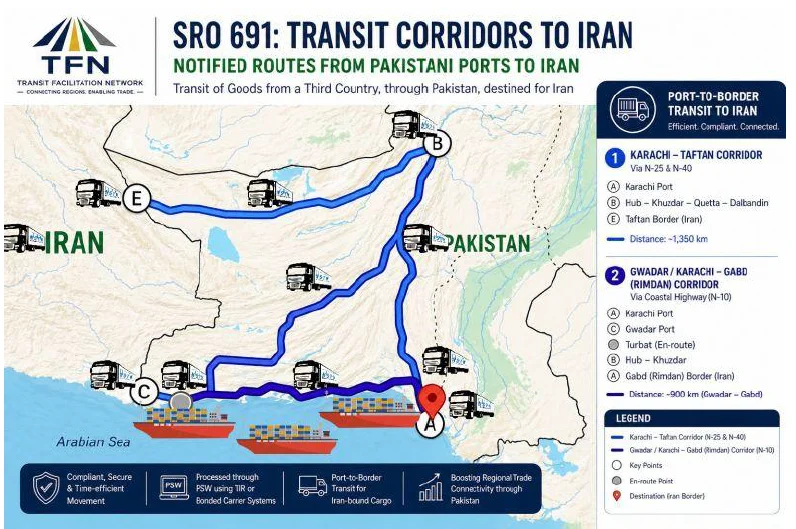
🔹 SRO 691(I)/2026 notifies designated routes connecting Pakistan’s ports with Iran.
🔹 CGO-05/2026 provides the customs operating procedure covering both the TIR regime and the bilateral transit regime.
🔹 Most importantly, the Ministry confirms that cross-stuffing under Para C of CGO-05 applies to both TIR and Transit regimes.
🔹 This enables international cargo arriving at Pakistani ports to use Pakistan as a sea-to-road transit gateway for onward movement to Iran, subject to prescribed customs procedures.
🔹 The Ministry has also confirmed that the TIR and Transit Trade customs procedures are already automated. Only minor updates to existing WeBOC modules are required for smooth operationalization of CGO-05, and implementation has already been initiated.
Why This Matters
Pakistan no longer needs to view Iran-bound cargo only through the lens of bilateral trade.
The combination of Karachi/Gwadar ports + cross-stuffing + road transit + TIR/bilateral transit options creates the regulatory foundation for Pakistan to compete for international cargo destined for Iran.
It could generate additional port throughput, terminal activity, trucking demand, warehousing, customs services and logistics revenue, while strengthening Pakistan’s role in regional connectivity.
TFN Assessment:
SRO 691 creates the routes. CGO-05 provides the operating framework. Cross-stuffing provides the multimodal flexibility. WeBOC automation can make the corridor commercially executable.
The next priority must be rapid operationalization at ports and borders, so that regulatory facilitation translates into actual cargo volumes.