Issued by: The Trade Facilitation Network
Date: May 2026
1. Executive Summary
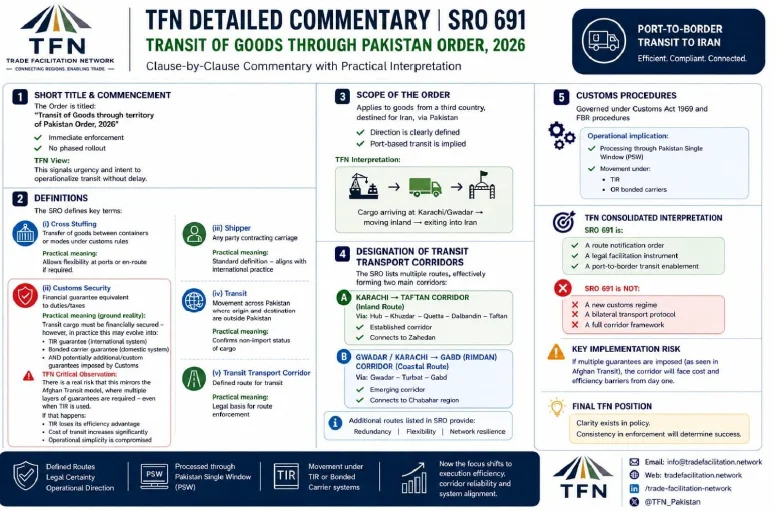
The Government of Pakistan, through the Ministry of Commerce, has issued SRO 691(I)/2026 – Transit of Goods through Territory of Pakistan Order 2026, enabling transit of third-country goods to Iran via Pakistan.
The order:
• Is legally in force
• Defines procedures and corridors
• Is intended for immediate implementation
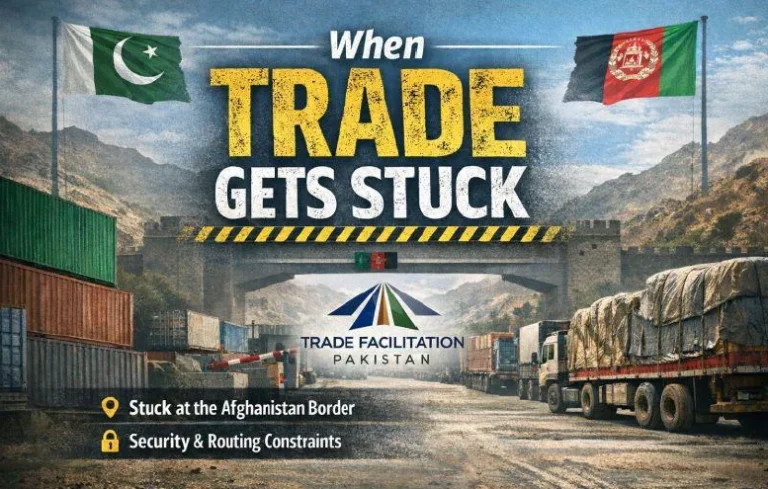
However, cargo destined for Iran arriving at Pakistani ports and borders is not being allowed to transit through Pakistan.
This reflects a clear institutional implementation failure, primarily at the level of enforcement by Federal Board of Revenue.
2. Policy Position
TFN asserts:
➢ SRO 691 is not ineffective. It is not being implemented.
There is:
• No policy ambiguity
• No legal gap
• No shortage of licensed operators
➢ The barrier is institutional, not structural.
3. Established Legal and Operational Framework
3.1 Valid Legal Instrument
SRO 691:
• Provides a complete legal basis for transit
• Applies to third-country cargo destined for Iran
• Is effective immediately upon issuance
3.2 Existing Operational Mechanisms
Transit is already supported through:
Customs bonded carriers
TIR operators
Ministry-approved transporters
Additionally:
• Procedures fall under existing Customs laws and systems
• No new operational regime is required
• 👉 Conclusion:
The system is already designed to operate.
4. The Actual Problem: Institutional Non-Executioncution
Despite:
• Legal notification
• Available operators
• Established procedures
Transit cargo is being stopped from moving across Pakistani territory toward Iran.
This indicates:
A. Breakdown Between Policy and Enforcement
- Ministry of Commerce has enabled transit
- Implementation authority lies with Customs (FBR)
- Execution is not aligned with policy intent
B. Administrative Resistance
- Field-level restrictions overriding federal policy
- Excessive controls beyond notified framework
- Absence of clear execution directives
4. Institutional Fragmentation
C. Policy issued by one ministry
D. Implementation controlled by another authority
E. No unified command or accountability
F. 👉 Result:
A legally valid corridor remains blocked in practice.
5. Implications
Failure to implement SRO 691 has immediate consequences:
• Loss of transit trade credibility
• Diversion of cargo to alternative regional routes
• Increased informal trade flows
• Erosion of investor and operator confidence
At a strategic level, Pakistan risks losing its position to regional competitors such as:
• Iran
• China
• Afghanistan
6. Key Policy Concern
A fundamental governance issue emerges:
When a federal policy is notified but not implemented by the executing authority, the challenge is no longer regulatory—it is institutional.
7. Required Action (Immediate)
TFN recommends the following non-negotiable steps:
7.1 Enforcement Alignment Directive
The Federal Government must issue a clear directive ensuring that:
• Federal Board of Revenue fully implements SRO 691
• Field formations comply without deviation
7.2 Removal of Operational Restrictions
• Transit cargo to Iran must be allowed to move without administrative obstruction
• No additional conditions beyond the SRO framework should be imposed
7.3 Institutional Accountability
• Assign clear responsibility for implementation
• Establish monitoring and reporting mechanism
7.4 Immediate Activation of Transit Flows
• Cargo already at ports/borders must be cleared for onward transit
• Licensed operators must be allowed to operate
8. Conclusion
Pakistan has already:
• Issued the policy
• Defined the corridors
• Enabled the legal framework
• Yet: 👉 Transit is not happening
➢ This is not a capacity issue.
➢ This is not a policy issue.
➢ This is an implementation failure at the institutional level.
9. TFN Position
The Trade Facilitation Network states:
➢ A corridor that is notified but not operational is not a policy success—it is an institutional failure
10. Final Call
The Government of Pakistan must ensure:
➢ Immediate enforcement of SRO 691
➢ Alignment between policy and execution
➢ Restoration of credibility in transit trade
Prepared by:
The Trade Facilitation Network (TFN)
Policy & Corridor Development Desk