Date: 7-3-2026
Prepared by
The Trade Facilitation Network (TFN)
Data Sources Intended for Validation
• Pakistan Bureau of Statistics
• Trade Development Authority of Pakistan
• Karachi Port Trust
• Port Qasim Authority
• Shipping lines operating Pakistan–GCC routes
1. Executive Summary
Pakistan’s perishable export sector is highly exposed to maritime disruption in the Strait of Hormuz, the primary chokepoint connecting Pakistan’s Arabian Sea shipping routes with Gulf markets.
Nearly all exports destined for:
• UAE
• Saudi Arabia
• Qatar
• Kuwait
• Bahrain
must transit through the Strait of Hormuz.
Pakistan exports approximately:
$1.6–1.7 billion worth of perishable commodities annually, including meat, seafood, fruits, and vegetables.
This equals roughly:
• $140 million per month
• ≈ 820 refrigerated containers per week
A prolonged disruption could lead to $60–85 million monthly export losses, along with severe supply chain disruption for Pakistan’s food exporters.
2. Strategic Maritime Exposure
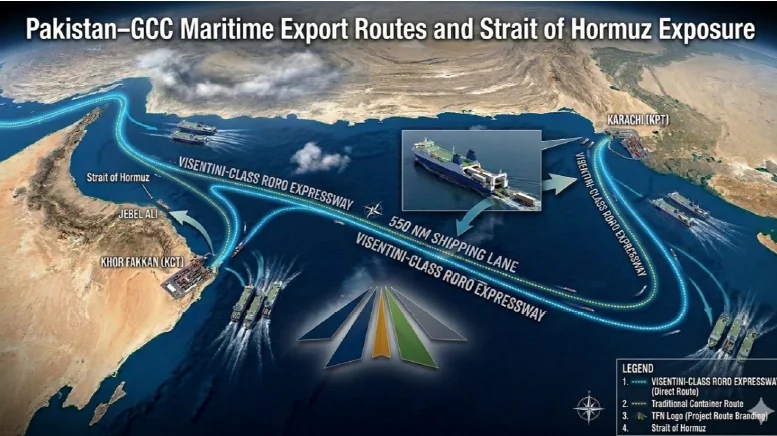
Pakistan’s maritime exports to GCC markets originate mainly from:
• Karachi Port
• Port Qasim
These ports handle the vast majority of Pakistan’s maritime cargo.
Export vessels departing these ports follow shipping lanes through the Arabian Sea and then pass through the Strait of Hormuz to enter Gulf ports such as:
• Jebel Ali
• Khalifa Port
• Hamad Port
• Dammam Port
As a result, Pakistan’s food exports to the Gulf are directly vulnerable to geopolitical disruptions in this maritime corridor.
3. Perishable Export Sector Overview
Based on official trade statistics, Pakistan exports the following high-value perishable commodities annually.
Commodity – Estimated Annual Export Value
• Meat ~$450 million
• Seafood ~$489 million
• Vegetables ~$399 million
• Fruits ~$333 million
• Total annual perishable exports: ≈ $1.67 billion
• Monthly equivalent: ≈ $135–140 million
4. Reefer Container Export Flow
Using standard logistics cargo density calculations:
• Average value per refrigerated container: ≈ $40,000
• Estimated annual refrigerated containers exported: ≈ 41,750 containers
• Monthly: ≈ 3,480 containers
• Weekly: ≈ 820 refrigerated containers
• These shipments depend on continuous maritime access to Gulf ports.
5. Logistics Sensitivity of Perishable Cargo
Perishable commodities have strict delivery windows.
Commodity Maximum Transit Window
• Seafood 3–5 days
• Chilled meat 7–10 days
• Vegetables 5–8 days
• Fruits 7–12 days
Delays beyond these windows result in:
• cargo rejection
• price discounts
• spoilage losses
6. Strait of Hormuz Disruption Scenarios
Scenario 1 – 7 Day Closure
• Weekly export value: ≈ $32–35 million
• Estimated spoilage risk: 10–15%
• Estimated losses: $3–5 million
Scenario 2 – 30 Day Disruption
• Monthly exposure: ≈ $140 million
Impact Category Estimated Loss
• Cargo spoilage $25–35MS
• Shipment cancellations $20–30MP
• rice discounts $15–20M
Total estimated monthly loss: $60–85 million
Scenario 3 – 90 Day Conflict
Long-term effects may include:
• loss of market contracts
• GCC importers switching suppliers
• reduced export volumes
Estimated losses:
• $200–300 million
7. Operational Impact on Ports
Disruption would quickly affect port operations.
Expected impacts include:
• reefer container backlog at ports
• increased electricity demand for refrigerated containers
• vessel schedule disruptions
• storage congestion
Port congestion may begin within 3–4 days of shipping disruption.
8. Strategic Export Risk
Pakistan’s food exports compete with suppliers from:
• Brazil
• India
• Turkey
• Iran
If shipping disruptions persist, Gulf buyers may switch to these alternative suppliers.
This creates a long-term risk of market displacement for Pakistani exporters.
9. Strategic Mitigation Options
Pakistan must develop alternative logistics solutions to reduce reliance on vulnerable maritime chokepoints.
Alternative Maritime Gateways
Possible Gulf entry ports include:
- Khor Fakkan Port
- Sohar Port
These ports provide better regional connectivity and access to Gulf road networks.
Fast Maritime-Road Gateway
Develop high-speed freight ferry routes transporting TIR refrigerated trailers directly across the Arabian Sea.
Such corridors would:
• shorten transit time
• protect cold chains
• bypass container congestion
10. Strategic Opportunity: Pakistan–UAE Ferry Corridor
A ferry corridor between Karachi and Khor Fakkan could provide:
• direct transport of refrigerated trailers
• faster delivery to GCC markets
• reduced cargo handling
Operational model:
| PARAMETERS | VALUE |
|---|---|
| • Trailer capacity per sailing | 140 |
| • Round trips per month | 7 |
| • Voyages per month | 14 |
| • Weekly sailings | ≈ 3.2 |
| • Weekly trailer capacity | ≈ 450 trailers |
| • Potential market demand | 330–410 trailers per week |
This suggests strong utilization potential for a single ferry vessel.
Conclusion
Pakistan exports approximately $140 million of perishable goods every month through maritime routes exposed to the Strait of Hormuz.
A major disruption in this corridor could result in monthly losses of $60–85 million, along with long-term damage to Pakistan’s export competitiveness.
Developing alternative logistics corridors and rapid maritime transport solutions is therefore critical to protect Pakistan’s food export economy.