Date: 12-2-2026
TFN Policy Perspective | Trade Facilitation Network
Pakistan’s logistics competitiveness debate often begins with infrastructure — roads, ports, rail connectivity, and digital trade platforms.
But a more foundational issue remains largely unaddressed:
Freight liability in road transport is structurally weak.
Nearly 96% of inland freight movement in Pakistan takes place by road. Yet a significant portion of this movement operates within forwarding structures where:
• The legally responsible carrier is not clearly defined;
• Risk is contractually diffused across multiple actors;
• Insurance penetration remains minimal or inconsistent;
• Shipment-level performance data is not systematically captured.
This creates embedded uncertainty across the supply chain.
And uncertainty is expensive.
The Hidden Cost of Undefined Liability
When freight liability is unclear:
• Insurance markets cannot properly price risk;
• Exporters cannot objectively benchmark service reliability;
• Financial institutions face difficulty pricing logistics risk in trade finance;
• Disputes increase transaction costs and delay settlements;
• Performance measurement remains perception-based rather than data-driven.
In short, Pakistan does not yet have a structured freight risk market.
Without a structured risk market, logistics costs remain inflated — not only due to infrastructure gaps, but due to systemic uncertainty.
A Market-Based Reform Starting Point
The Trade Facilitation Network (TFN) proposes that logistics reform must begin at the transaction level through:
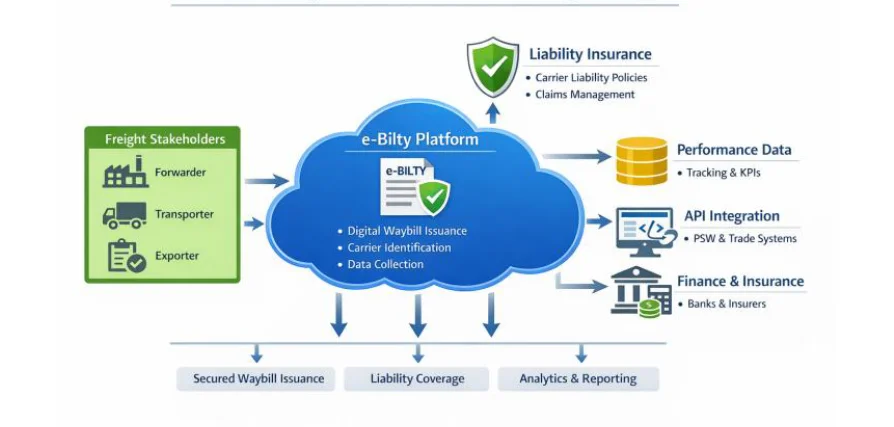
A National e-Bilty Platform backed by Carrier Liability Insurance
This is not a regulatory replacement. It is a private-sector-led commercial infrastructure layer.
Under this framework:
• Every shipment is digitally documented;
• A clearly identified legally responsible carrier is recorded;
• Carrier liability insurance is integrated at issuance;
• Structured shipment-level data is generated;
• Interoperability with regulator-backed systems (e.g., Pakistan Single Window) is enabled via API integration.
Once liability is insured, discipline improves. Once discipline improves, reliability increases. Once reliability increases, performance becomes measurable.
Competitiveness then becomes a natural outcome — not a forced metric.
Linking Freight Formalization to Sustainable Development
Freight liability reform is not merely a commercial matter. It directly supports multiple Sustainable Development Goals:
SDG 8 – Decent Work & Economic Growth
Formalizing road freight operations brings informal activity into structured, insurable frameworks — strengthening economic resilience and productivity.
SDG 9 – Industry, Innovation & Infrastructure
A digital liability-backed waybill system enhances trade infrastructure reliability and enables data-driven logistics modernization.
SDG 16 – Strong Institutions & Transparency
Clear liability assignment reduces disputes, strengthens contractual accountability, and builds trust across supply chains.
SDG 13 – Climate Action
Structured shipment-level data enables route optimization, performance analytics, and fuel efficiency benchmarking — supporting long-term emissions reduction.
Thus, freight liability formalization contributes simultaneously to competitiveness, institutional strengthening, and sustainability.
Reducing Uncertainty to Reduce Cost
Pakistan’s logistics costs as a share of GDP remain elevated compared to regional benchmarks.
While infrastructure investment remains critical, cost reduction also requires reducing uncertainty.
Undefined liability is one of the largest hidden sources of uncertainty in freight movement.
By formalizing freight risk:
• Insurance penetration improves;
• Cargo dispute frequency declines;
• Financial confidence strengthens;
• Corridor reliability becomes measurable;
• Export competitiveness improves structurally.
A PPP Pathway Forward
TFN proposes advancing this initiative under a Public-Private Partnership (PPP) framework:
• Government provides enabling recognition and policy alignment;
• The private sector develops and operates the digital liability infrastructure;
• The insurance sector underwrites structured freight risk;
• Exporters and logistics firms adopt performance-driven participation.
This is a commercially sustainable reform pathway — not a subsidy-driven intervention.
Conclusion: Fix the Foundation First
Logistics reform cannot rely solely on infrastructure expansion or digital tracking tools.
It must begin with financial accountability at the shipment level.
If freight risk is formalized and insured, performance discipline follows. If performance discipline follows, competitiveness strengthens. If competitiveness strengthens, export growth becomes sustainable.
Reform built on structured liability is structural reform — not cosmetic reform.
The time has come to move from informal freight to accountable logistics.
Trade Facilitation Network (TFN) Advancing structured, resilient, and competitive trade ecosystems.