Date: 24-1-2026
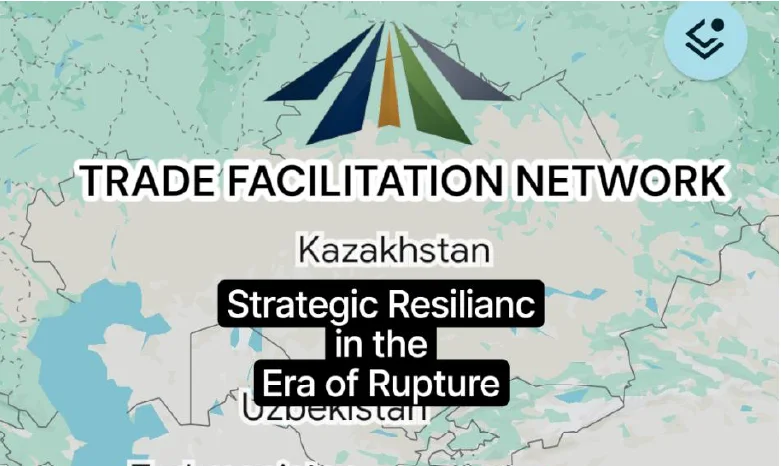
As global leaders highlighted at the World Economic Forum, the international system is no longer evolving through gradual transitions — it is entering an era of structural rupture. Supply chains, capital flows, technology regimes, and geopolitics are fragmenting simultaneously. In this environment, connectivity is no longer only about efficiency or cost — it is fundamentally about sovereign resilience, redundancy, and control over strategic trade arteries.
The announced visit of President Kassym-Jomart Tokayev to Islamabad on 3 February 2026 to formalize a proposed $7 billion Pakistan–Kazakhstan rail connectivity framework represents a potentially transformative development for Eurasian logistics architecture. The vision — linking Karachi and Gwadar to Central Asia via a Western alignment through Chaman and Turkmenistan — aims to compress timelines, diversify transit dependencies, and rebalance continental trade flows.
From the perspective of the Trade Facilitation Network (TFN), this initiative should be understood not merely as a bilateral infrastructure project, but as a regional system-building exercise with implications for customs harmonization, transit governance, corridor finance, digital compliance, and multimodal interoperability.
From Offshore Dependence to Strategic Autonomy
For decades, South–Central Asia connectivity was treated as an “offshore” logistics extension — dependent on distant maritime routing, third-country chokepoints, and fragmented regulatory regimes. That model delivered scale but not resilience.
Today, the strategic paradigm is shifting toward reshoring and friend-shoring of transit security — building direct, high-capacity corridors that remain operational even under geopolitical stress. Rail connectivity between Pakistan and Central Asia is not only about shortening distances; it is about restoring regional agency over trade continuity, customs enforcement, and supply assurance.
TFN views this shift as a necessary recalibration: resilient corridors require not only steel and concrete, but also institutional alignment, legal predictability, interoperable digital systems, and coordinated border governance.
Navigating Transactional Geopolitics with Institutional Anchors
The re-emergence of transactional diplomacy in major power relations reinforces the importance of embedding large infrastructure projects within globally compatible standards and governance frameworks.
Three strategic dimensions are particularly relevant:
1. Technology and Standards Alignment
Infrastructure anchored in globally recognized technical standards — rolling stock compatibility, signaling systems, safety regimes, data protocols — improves long-term bankability and political durability. Alignment with internationally accepted technologies creates interoperability with broader supply chains rather than isolated regional corridors.
2. Resource-Linked Trade Corridors
Central Asia’s critical minerals, energy inputs, and industrial feedstocks increasingly anchor global supply strategies. Corridors that efficiently move these resources to diversified maritime gateways become strategic assets for global manufacturing and energy transition ecosystems — not merely regional trade lanes.
3. Financial Stability and Risk Insulation
While alternative settlement mechanisms attract strategic interest, near-term corridor viability depends on predictable financing structures, currency stability, and compliance compatibility with international lenders and insurers. A pragmatic dual-track approach — stabilizing dollar-based financing while selectively piloting bilateral clearing mechanisms — reduces volatility exposure without undermining investor confidence.
Beyond Infrastructure: The Governance Challenge
TFN emphasizes that the real determinant of corridor success lies in execution governance, not headline investment figures. This includes:
• Harmonized transit regimes (TIR, CIM readiness, customs data exchange)
• Digitized cargo visibility and compliance assurance
• Integrated border management coordination
• Corridor performance monitoring and dispute resolution mechanisms
• Private sector participation frameworks
• Risk allocation and operational sustainability models
• Without institutional integration, even world-class infrastructure underperforms.
Conclusion: Building a Credible “Middle Hub”
The Pakistan–Kazakhstan rail vision represents an opportunity to shape a credible Middle Hub connecting South Asia, Central Asia, the Middle East, and Eurasia. In a fragmented global environment marked by weaponized interdependence, the strategic advantage lies not in isolation, but in trusted, rules-based, resilient connectivity ecosystems.
TFN views this initiative as a platform for advancing:
• Corridor governance reform
• Trade facilitation modernization
• Digital enforcement architectures
• Regional policy coordination
• Private sector confidence
Geography alone does not create competitiveness — institutions, interoperability, and execution discipline do.