Date: 15-1-2026
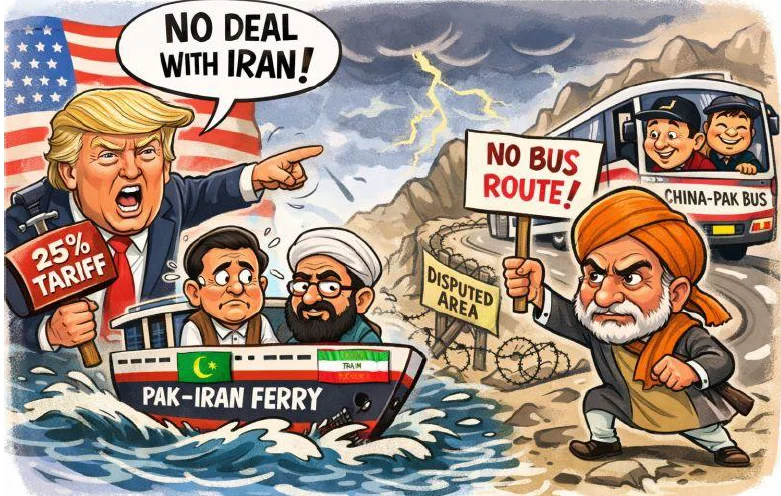
The recent statement by U.S. President Donald Trump threatening a 25% tariff on any country engaging in economic activity with Iran — regardless of scale or sector — adds a new layer of uncertainty for regional trade and connectivity planning.
While presented as a sanctions enforcement measure, the signal is broader: commercial engagement itself is being politicized and externally conditioned. For countries like Pakistan, whose exports remain highly dependent on access to the U.S. market, even small or experimental connectivity initiatives with Iran — such as a nascent ferry service — may now carry disproportionate geopolitical exposure, regardless of commercial viability.
This development mirrors a regional precedent.
Several years ago, India objected to a proposed China–Pakistan cross-border bus service, not on economic or operational grounds, but because the route passed through disputed territory. The project itself was modest, yet it was treated as strategically consequential — because infrastructure creates legitimacy, normalization, and permanence.
In both cases, a common pattern emerges:
Connectivity projects are increasingly judged not by economic merit, but by geopolitical alignment and strategic signaling.
Market access, sanctions, and sovereignty claims are being used as leverage to shape third-party behavior. Even limited trade or transport initiatives become symbolic flashpoints in larger geopolitical contests. This shifts trade facilitation away from predictable, rules-based frameworks toward power-conditioned access.
For Pakistan and the wider region, this trend matters deeply. Connectivity is not a political luxury — it is a development necessity. Yet externalized political risk discourages private investment, raises insurance and compliance costs, slows experimentation, and fragments regional integration.
TFN views this trajectory with concern.
Trade facilitation and connectivity must remain anchored in predictability, transparency, proportionality, and multilateral rules. When commercial corridors become hostage to geopolitical signaling, smaller economies bear the greatest risk — and regional prosperity is delayed.
Connectivity should build economic resilience — not become collateral damage of geopolitical competition.
Trade Facilitation Network (TFN)