Date: 14-1-2026
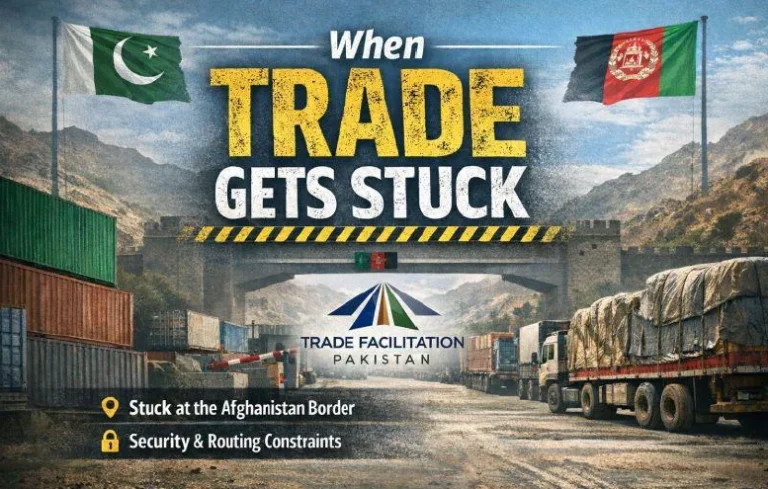
Pakistan’s Ministry of Commerce has issued a one-time waiver allowing the re-export of Afghan transit cargo stranded at Karachi ports and land border crossings following prolonged border disruptions. Thousands of containers have accumulated demurrage exposure, with additional congestion reported at Chaman and Torkham.
While this measure provides short-term operational relief, it also highlights a deeper structural challenge: regional transit corridors remain vulnerable to disruption due to limited predictability, fragmented visibility, and reactive governance mechanisms.
Market behavior responds quickly to uncertainty. When cargo faces repeated border interruptions, demurrage escalation, financing exposure, insurance risk, and delivery unreliability, supply chains naturally re-route toward alternative corridors — often permanently. The reported contraction in Afghan transit volumes reflects this confidence erosion rather than purely cyclical trade dynamics.
From a trade facilitation perspective, three systemic risks stand out:
1. Commercial Risk Concentration
Unpredictable border operations shift financial risk onto private operators without structured mitigation or contingency frameworks.
2. Corridor Credibility Degradation
Transit corridors compete on reliability, transparency, and governance consistency. Once credibility weakens, recovery becomes slow and costly.
3. Limited Digital Predictability
Absence of real-time cargo intelligence, integrated border visibility, and predictive congestion management prevents proactive intervention and coordinated response.
TFN Position
Trade Facilitation Network (TFN), as a Non-Partisan, Independent, and Transparent platform, emphasizes that episodic administrative waivers cannot substitute for institutional reform.
Sustainable transit competitiveness requires:
- End-to-end digital cargo visibility
- Harmonized multi-agency enforcement protocols
- Predictable border operating regimes
- Risk-based compliance frameworks
- Embedded public–private coordination mechanisms
Transit trade is not merely a customs process. It is a strategic economic infrastructure asset that determines national credibility, investor confidence, and long-term regional connectivity positioning.
TFN will continue engaging public and private stakeholders to promote evidence-based, system-driven solutions for resilient and competitive trade corridors.