Date: 23-2-2026
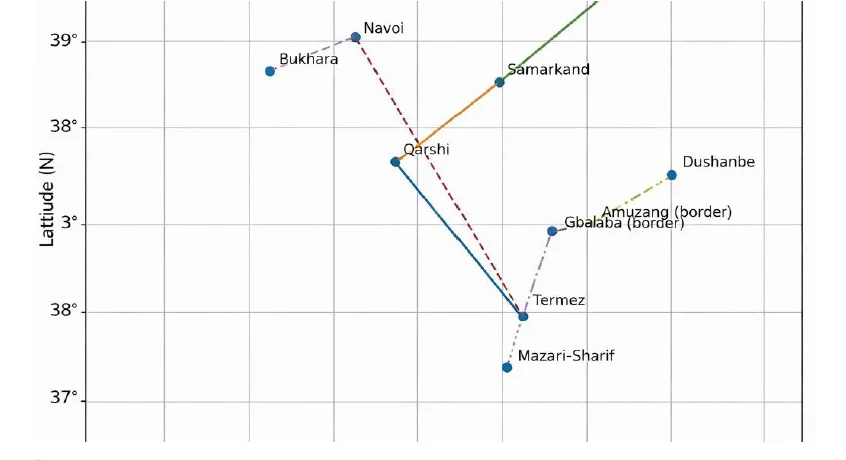
A functional southern trade spine already links:
• Kulma Pass
• Dushanbe
• Termez
• Navoi
• Kabul
• Peshawar
What is required now is not new infrastructure—but policy synchronization aligned with regional programs, particularly:
Economic Cooperation Organization (ECO)
Central Asia Regional Economic Cooperation Program (CAREC)
Embedding this corridor within ECO and CAREC priorities significantly increases institutional weight, financing viability, and political endorsement.
1. Strategic Alignment with ECO
ECO’s Transit Transport Framework Agreement (TTFA) aims to:
• Facilitate seamless transit among member states
• Reduce border bottlenecks
• Harmonize customs documentation
• Improve multimodal connectivity
The Kulma–Termez–Peshawar spine directly operationalizes TTFA principles by:
✔ Linking multiple ECO member states
✔ Strengthening north–south transit flows
✔ Enabling Afghanistan’s structured integration
✔ Enhancing trade facilitation compliance
This corridor can serve as a demonstration project under ECO TTFA modernization efforts.
2. Strategic Alignment with CAREC
The Central Asia Regional Economic Cooperation Program has prioritized:
• Regional transport corridors
• Trade facilitation modernization
• Customs digitalization
• Corridor performance monitoring
CAREC Corridor 2 and Corridor 6 frameworks already overlap geographically with segments of this proposed spine.
By integrating:
• Digital shipment tracking
• Border performance indicators
• Rail capacity optimization
• Multimodal harmonization
This initiative aligns directly with CAREC’s Transport Strategy 2030.
3. Quantified Regional Opportunity
Addressable Freight Pool
| Segment | Est. Annual Volume (MT) |
|---|---|
| China–Tajikistan | 1.5–2.0 |
| Tajikistan–Uzbekistan | 3.0–5.0 |
| Uzbekistan–Afghanistan | 3.0–4.0 |
| Afghanistan–Pakistan | 1.0–2.0 |
Total addressable pool: 8–12 million tons
Reform Scenario (5-Year)
| Year | Conservative | ECO/CAREC Supported Reform |
|---|---|---|
| • Year 1 | 2 MT | 3 MT |
| • Year 3 | 4 MT | 6 MT |
| • Year 5 | 5.5 MT | 8 MT |
Logistics cost reduction potential: 15–30%
Regional logistics economy impact: USD 250–400 million annually
4. Institutional Leverage Through ECO & CAREC
Embedding the corridor in ECO and CAREC structures enables:
• Multilateral technical assistance
• Border modernization funding
• Corridor performance measurement
• Political coordination platform
• DFI participation (ADB, IsDB, AIIB)
It transforms a bilateral logistics initiative into a recognized regional integration project.
5. Policy Priorities Under ECO & CAREC Umbrell
A. Customs Digitalization
- Advance electronic data exchange
- Pre-arrival processing
- Mutual recognition of inspections
B. Transit Guarantee Harmonization
- Recognition of bonded transit across member states
- Reduced documentary redundancy
C. Rail Coordination
- Predictable block train allocation
- Transparent corridor tariff schedules
D. Corridor KPI Dashboard
Border dwell time measurement
• Cost benchmarking
• Transit reliability tracking
These are fully consistent with CAREC corridor performance monitoring mechanisms.
6. Afghanistan Stabilization Through Structured Integration
Both ECO and CAREC emphasize inclusive regional development.
A formalized multimodal corridor:
• Strengthens Afghanistan’s transit economy
• Reduces informal cross-border leakage
• Enhances customs revenue transparency
• Encourages private-sector logistics participation
Economic connectivity becomes a stabilizing instrument.
7. Strategic Importance for China & Pakistan
For China:
• Western export diversification
• Complementary BRI routing
• Reduced overdependence on northern transit routes
For Pakistan:
• Structured northbound Central Asian access
• Trade diversification
• Integration with regional transit frameworks
8. Why Institutional Framing Matters
Without ECO/CAREC alignment, this corridor remains:
A fragmented operational route
With ECO/CAREC endorsement, it becomes:
• A recognized regional priority corridor
• Eligible for technical and financial support
• Politically shielded through multilateral legitimacy
• Structured under formal monitoring frameworks
Final Assessment
The Kulma–Termez–Kabul–Peshawar spine is not a speculative concept.
It is an existing trade geography awaiting policy synchronization.
Embedding it formally within:
• Economic Cooperation Organization
• Central Asia Regional Economic Cooperation Program
provides the institutional weight required to transform it into a fully operational, regionally endorsed multimodal corridor.
Policy alignment—not new infrastructure—is the decisive factor.