Date: 6-4-2026
Pakistan is exporting ethanol… while importing expensive petrol.
This is not just a trade imbalance — it is a missed strategic opportunity.
The Reality: Ethanol in Pakistan
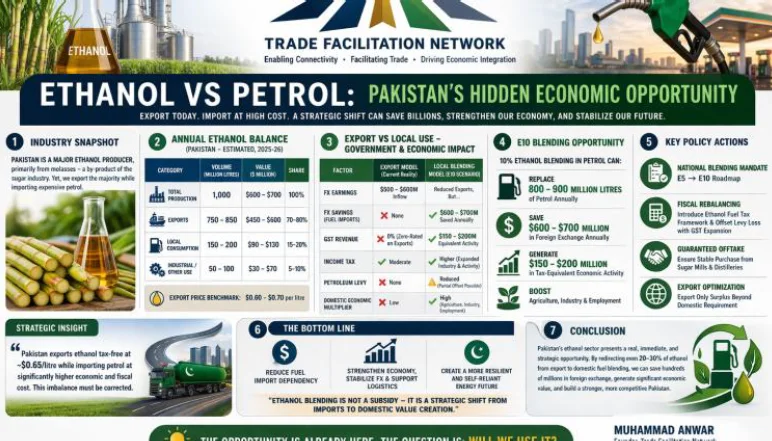
Pakistan produces approximately 1 billion litres of ethanol annually, primarily from molasses (a by-product of the sugar industry).
Current allocation:
- 70–80% exported
- 15–20% used locally (industrial use)
- Fuel blending: almost negligible
Export value:
- ~$450–600 million per year
- Average price: ~$0.60–0.70 per litre
The Core Imbalance
👉 We export ethanol at low fiscal value
👉 We import petrol at high economic cost
This creates a structural contradiction:
«Low-value exports vs high-cost imports»
What If Pakistan Adopts Ethanol Blending?
Let’s consider a modest E10 policy (10% ethanol blending in petrol)
Impact:
- Replace up to 800–900 million litres of petrol annually
- Save approximately $600–700 million in foreign exchange
Government Revenue – The Real Question
Many argue: “Government will lose petroleum levy”
Yes — partially.
But here’s the full picture
❌ Export Model:
- GST: 0% (zero-rated)
- Limited tax capture
- No impact on fuel imports
✅ Local Blending Model:
- GST: up to 18% on domestic activity
- Higher income tax from expanded industry
- Massive foreign exchange savings
- Strong multiplier effect (agriculture + industry)
Domestic Economic Impact
Shifting ethanol locally would:
- Boost sugarcane and agro-industrial value chain
- Increase industrial activity and employment
- Reduce pressure on foreign reserves
Why This Matters for Logistics
Fuel is 30–50% of transport cost.
Every increase in fuel price:
➡️ Raises freight cost
➡️ Increases food prices
➡️ Fuels inflation
Ethanol blending can:
- Reduce dependency on imports
- Stabilize fuel pricing
- Protect the logistics backbone of Pakistan
The Policy Gap
Pakistan currently lacks:
- A national ethanol blending mandate
- A pricing framework for fuel ethanol
- A balanced tax structure (levy vs GST)
The Strategic Way Forward
✔ Introduce E5 → E10 roadmap
✔ Allocate 20–30% ethanol for domestic fuel use
✔ Redesign tax structure to offset levy loss
✔ Ensure guaranteed offtake for producers
The Bottom Line
«Pakistan is exporting ethanol tax-free while importing fuel at a high economic cost.»
This is not just inefficient — it is unsustainable.
Policy Insight
«Ethanol blending is not a subsidy — it is a strategic shift from imports to domestic value creation»
Final Thought
If managed correctly, ethanol can become:
- A foreign exchange stabilizer
- A logistics cost reducer
- A domestic industry multiplier
The opportunity is already here.
The question is: Will we use it?
Muhammad Anwar
Founder
Trade Facilitation Network