Date: 23-3-2026
Submitted by: The Trade Facilitation Network (TFN) – R&D Win
For: Ministry of Maritime Affairs, Government of Pakistan
- Executive Decision Statement
The disruption risk in the Strait of Hormuz is already imposing significant real-time economic costs on Pakistan, estimated in the range of:
PKR 1.2 – 1.8 trillion annualized impact (USD 4.3 – 6.5 billion)
Simultaneously, Pakistan has a time-sensitive opportunity to generate:
PKR 2.5 – 4.0 trillion incremental economic gains (USD 9 – 14 billion)
within 2–3 years through rapid activation of TFN-recommended logistics corridors
- Current Economic Losses (Quantified Impact)
2.1 Energy Import Shock
Pakistan imports ~70–80% of its energy via Gulf routes
Oil price increase (~USD 60 → 110/barrel)
~ Impact:
Additional annual fuel import burden:
USD 3 – 4 billion
PKR 850 billion – 1.1 trillion
2.2 Freight & Insurance Cost Surge
War-risk premiums increased 3x–7x
Ocean freight up 25–40%
~ Impact:
Additional logistics cost on imports/exports:
USD 1 – 1.5 billion annually
2.3 Trade Slowdown & Industrial Impact
Higher input costs → reduced industrial output
Export competitiveness decline
~ Impact:
Estimated export loss:
USD 0.8 – 1.2 billion
2.4 Currency & Inflation Spillover
Pressure on PKR due to higher import bill
Fuel-driven inflation across:
▪ Food
▪ Transport
▪ Manufacturing
~ Macroeconomic effect:
GDP drag: 1.5% – 2.0%
- Total Immediate Loss Estimate
Energy Imports : USD 3.0 – 4.0 B
Freight & Insurance : USD 1.0 – 1.5 B
Export Loss : USD 0.8 – 1.2 B
Total Loss : USD 4.8 – 6.7 B
- Strategic Opportunity: Quantified Gains
4.1 Transit Trade Revenue Potential
If Pakistan captures even:
5–10% of diverted regional cargo flows
~ Potential:
USD 3 – 5 billion annually
Through:
▪ Transit fees
▪ Handling charges
▪ Warehousing
4.2 Gwadar as Strategic Hub
Transshipment + overflow cargo
~ Potential:
USD 1 – 2 billion annually
4.3 Multimodal Corridor Development
Pakistan–Iran–Central Asia routes
China-West Asia connectivity
~ Potential:
USD 2 – 4 billion economic activity
4.4 Industrial & Logistics Spillover
Dry ports, trucking, warehousing
Job creation (50,000–100,000 jobs)
~ GDP contribution:
+2% to 3% uplift over 3 years
- Net Strategic Outcome
Scenario – Outcome
No Action – USD 5–7 B annual loss continues
TFN Policy Adoption – USD 9–14 B gains within 2–3 years
Net Swing – USD +15–20 B economic turnaround
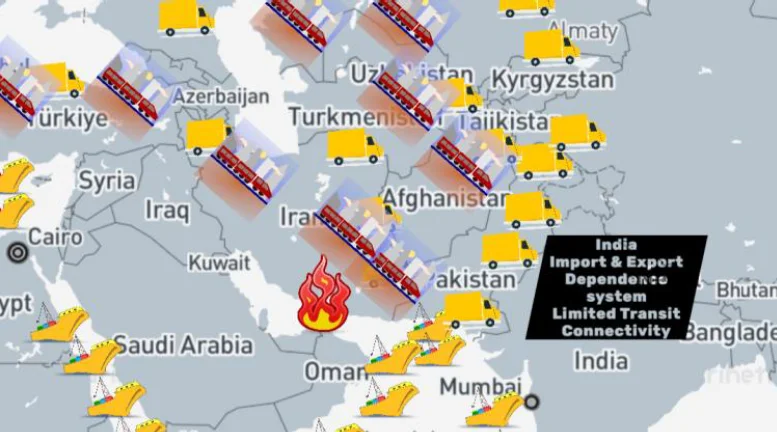
- Why India Will Not Capture This Opportunity
Ports like Mundra Port and Jawaharlal Nehru Port are:
Designed for domestic + global maritime trade
Not positioned as land bridge transit corridors
~ India’s strategy = risk mitigation
~ Pakistan’s opportunity = trade rerouting hub
- Immediate Policy Actions
7.1 Declare “National Logistics Emergency”
Fast-track approvals for:
Transit corridors
Border facilitation
7.2 Launch “Pakistan Transit Corridor Initiative (PTCI)”
Branded international offering:
Gulf → Pakistan → Central Asia/China
7.3 Gwadar Fast Activation (90-Day Plan)
Zero-duty incentives for transshipment
Dedicated shipping window
7.4 TIR Corridor Scaling
Pakistan–Iran–Central Asia routes operational within 30 days
7.5 Public-Private Execution
TFN proposes:
▪ Immediate pilot corridors
▪ Engagement with:
▪ Shipping lines
▪ Freight forwarders
▪ Central Asian partners
- Strategic Warning
This opportunity is time-bound (3–6 months window)
If Pakistan does not act:
Cargo will reroute via:
▪ Russia corridors
▪ Caucasus routes
▪ Indian-backed alternatives
~ Result: Permanent loss of strategic relevance
- TFN Strategic Position
• Pakistan is currently absorbing losses without capturing value.
With immediate policy activation:
• Pakistan can convert a geopolitical crisis into a national economic recovery engine.
- Conclusion
The crisis is already costing Pakistan USD 5–7 billion annually
The opportunity exists to generate USD 9–14 billion gains
The required investment is policy speed—not capital intensity
Recommended Immediate Directive:
Approve TFN-supported National Corridor Activation Plan within 30 days
Prepared by:
The Trade Facilitation Network (TFN)
Research & Development Wing