Date: 8-8-2026
Pakistan has geography that many countries would envy: three major ports, access to the Arabian Sea, and land connections towards China, Afghanistan, Iran and Central Asia. Yet geography alone does not create a successful transit corridor.
The numbers tell the story.
On 3–4 February 2026, Kazakhstan’s President Kassym-Jomart Tokayev visited Pakistan. Over 30 commercial agreements worth about US$200 million were announced, with a bilateral trade target of US$1 billion.
On 5–6 February 2026, Uzbekistan’s President Shavkat Mirziyoyev visited Pakistan. The two countries targeted US$2 billion bilateral trade, alongside a US$3.5 billion portfolio of prospective trade and investment projects. Transport connectivity featured prominently in both visits.
Pakistan further opened its transit architecture through SRO 691(I)/2026 on 25 April 2026, facilitating foreign cargo movement through Pakistani territory towards Iran.
But while agreements multiply, cargo figures provide a warning.
Pakistan handled only 11,592 Afghan transit containers worth US$367 million in FY2025–26, compared with 42,959 containers worth US$1.36 billion in FY2024–25 and 102,886 containers worth US$6.7 billion in FY2022–23.
That represents an almost 89% collapse in container volume in just three years. Afghan reverse transit through Pakistan also fell from US$454 million in FY2024–25 to only US$7 million in FY2025–26.
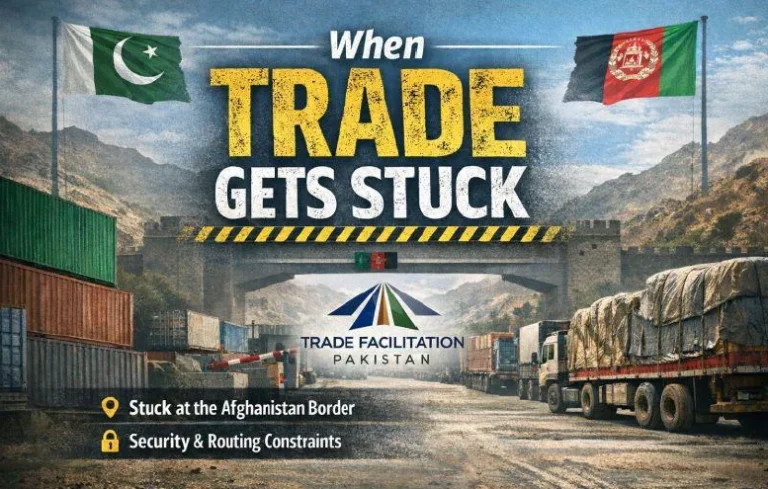
The prolonged Pakistan–Afghanistan border disruption accelerated the shift. Afghanistan did not stop trading—it increasingly turned towards Iran and Central Asian routes.
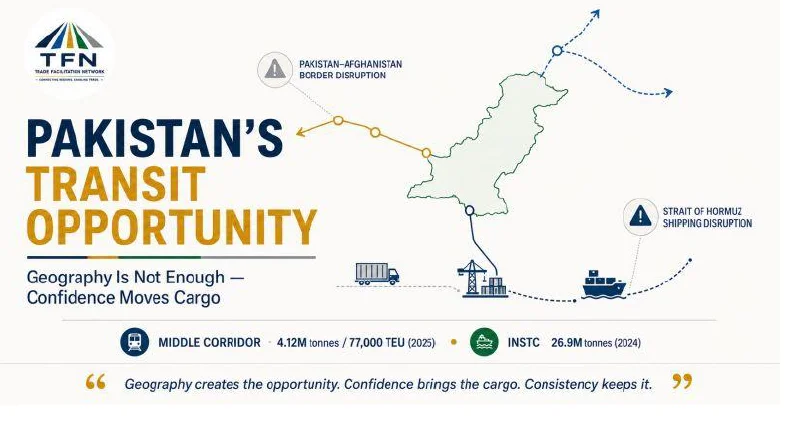
Meanwhile, competing Eurasian corridors are establishing commercial scale. The Middle Corridor moved about 4.12 million tonnes and 77,000 TEU in 2025, while the broader INSTC handled about 26.9 million tonnes in 2024.
Now another strategic opportunity has emerged.
The Strait of Hormuz has faced repeated disruption during 2026. Before the conflict, around 130–140 vessels crossed weekly; during 4–7 August, only 33 vessels transited. This creates an opportunity for cargo destined for Iran and beyond to discharge at Karachi, Port Qasim or Gwadar and move overland.
But Pakistan cannot benefit from instability elsewhere if its own corridors remain unpredictable.
Pakistan urgently needs Corridor Confidence-Building Measures (CBMs): predictable borders, cargo and driver security, uninterrupted Customs operations, competitive port costs, digital visibility, guaranteed transit procedures and institutional protection of commercial traffic from political disruptions.
The lesson is simple:
Afghan-border disruption shows how Pakistan can lose cargo.
Hormuz disruption shows how Pakistan can attract it.
Geography creates the opportunity.
Confidence brings the cargo.
Consistency keeps it.
Trade Facilitation Network (TFN)
Sources: Pakistan Ministry of Commerce; Dawn; Reuters; TITR/Middle Corridor data; Kazakhstan & Uzbekistan Presidential Offices.