Date: 15-3-2026
Date: 14th March 2026
Source: Trade Facilitation Network (TFN) – R&D Department
Abstract
In the wake of persistent geopolitical instability within the Strait of Hormuz and the Bab-el-Mandeb, global supply chains are facing a structural crisis of “chokepoint dependency.” This article explores the strategic repositioning of Pakistani ports—Karachi Port (KPT) and Port Qasim (PQA)—as primary transshipment and transit hubs. By leveraging their location outside the immediate “danger zones” of the Persian Gulf and Red Sea, these ports offer a viable bypass for commercial goods destined for Central Asia, Africa, and Europe, effectively de-risking the maritime silk road.
- The Vulnerability of Traditional Hubs
As of early 2026, the traditional transshipment model in the Gulf region is under severe duress. Our data indicates that ports such as Jebel Ali, Khalifa, and Dammam, while highly efficient, are currently hampered by:
• Geopolitical Bottlenecks: Increased insurance premiums (War Risk Surcharge) for vessels entering the Gulf.
• Physical Insecurity: Asymmetric threats in the Red Sea corridor impacting the predictability of Suez-bound trade.
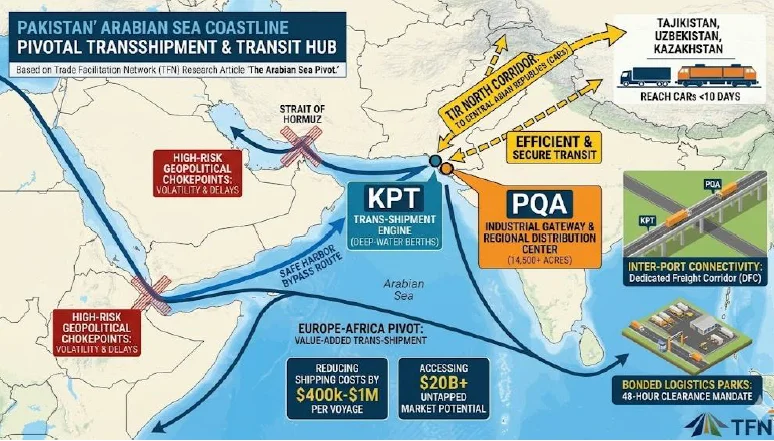
• Operational Delay: The necessity of convoy-based movements or significant rerouting around the Cape of Good Hope, adding $400k – $1M in fuel costs per voyage for ultra-large container vessels (ULCVs).
- The “Safe Harbor” Hypothesis: KPT and PQA
Pakistan’s coastline serves as the first major deep-water alternative outside the Strait of Hormuz. The Trade Facilitation Network (TFN) identifies two primary operational pillars:
A. Karachi Port Trust (KPT): The Transshipment Engine
KPT’s existing deep-water berths (SAPT) are capable of handling 18,000+ TEU vessels. Unlike Gulf ports, KPT offers direct access to the open sea, allowing shipping lines to avoid the “closed-loop” risks of the Persian Gulf.
• Strategic Offer: A “Dry Bypass” where motherships offload at KPT, and cargo is funneled into the TIR (International Road Transport) network or high-frequency Ro-Ro shuttles to serve the Gulf markets remotely.
B. Port Qasim (PQA): The Industrial Gateway
PQA represents the “Value-Added” segment of the strategy. With its vast industrial acreage, it can serve as a Regional Distribution Center (RDC) for African minerals and European finished goods.
• Future Scope: Transitioning from a simple transit point to a “Semi-Manufacturing Hub” where cargo for Central Asia is processed in-bond, reducing the final weight and cost of inland transport.
- Connecting the CARs (Central Asian Republics)
The TFN strategy emphasizes the North-South Connectivity Corridor. By utilizing the Quadrilateral Traffic in Transit Agreement (QTTA) and the Pakistan-Uzbekistan Transit Trade Agreement (AUPTT), cargo from Karachi can bypass the sanctioned northern routes and the volatile western routes.
• Time Efficiency: Reach Tashkent or Almaty in under 10 days from the port of discharge.
• Cost Efficiency: Reduction in maritime insurance costs by staying south of the Hormuz “high-risk area.”
- Resolving the “Efficiency Gap”
For Pakistan to capture this $20B+ potential, the TFN identifies three critical “Facilitation Hurdles” that must be resolved:
- Inter-Port Connectivity: The establishment of a Dedicated Freight Corridor (DFC) between KPT and PQA to allow seamless, 24/7 container movement, bypassing Karachi’s urban traffic.
- Digital Single Window: Full implementation of the Pakistan Single Window (PSW) to ensure that transshipment documentation is processed in hours, not days.
- Bonded Infrastructure: Development of “Logistics Cities” at port peripheries to allow international shipping lines to store empty containers and manage transshipment “swap” operations without tax liabilities.
- Conclusion
The shift from “Just-in-Time” to “Just-in-Case” logistics favors Pakistan. By positioning KPT and PQA as the safety valves of the Arabian Sea, Pakistan can provide the global shipping industry with a much-needed alternative to the current geopolitical chokepoints. This is not merely a national infrastructure project; it is a global trade stabilization necessity.