Date: 15-8-2026
TFN Analysis | Trade Facilitation Network
South Asia stands at an important point in the evolution of its maritime and regional trade architecture.
The region sits astride some of the world’s busiest shipping routes, contains one of the world’s largest concentrations of consumers and manufacturing activity, and provides maritime access toward the Middle East, Central Asia and wider Eurasia. Yet South Asia has historically captured only part of the economic value that its geography could generate.
That is beginning to change.
Countries across the region are investing in ports, terminals, industrial zones, logistics corridors, multimodal connectivity and export manufacturing. Transshipment is becoming increasingly important within this transformation.
But transshipment should not be understood simply as the transfer of a container from one vessel to another.
For a modern trading economy, it forms part of a much wider ecosystem involving shipping connectivity, consolidation and deconsolidation, cross-stuffing, bonded warehousing, re-export, multimodal transfer, processing, manufacturing and regional distribution.
The next stage for South Asia should therefore be not merely to increase container throughput, but to convert its geography into a sophisticated trade-facilitation platform.
South Asia’s Emerging Transshipment Geography
South Asia does not have a single transshipment model.
Sri Lanka has built Colombo into the region’s most established international transshipment platform. Its location close to the main East-West shipping route allows cargo originating elsewhere in the Indian Subcontinent to connect efficiently with global liner networks.
India, historically dependent on foreign hubs for a portion of its transshipment traffic, is pursuing greater domestic transshipment capability alongside enormous investments in ports, logistics corridors and manufacturing. Its strategy increasingly connects maritime infrastructure with industrial policy.
Bangladesh represents another model. Its significance lies less in becoming a global transshipment centre and more in its integration into international manufacturing supply chains. Imported raw materials and intermediate goods enter the country, undergo production, and leave as finished exports.
Pakistan, positioned on the Arabian Sea and at the maritime entrance to corridors extending toward China, Afghanistan, Central Asia, Iran and the Middle East, has a different potential role. Its opportunity includes maritime transshipment but extends toward multimodal transit, regional distribution and value-added trade.
These models are different, but collectively they demonstrate an important regional shift:
South Asia is moving from being a collection of national gateways toward becoming part of an interconnected regional trade system.
That transition requires modern transshipment rules.
Transshipment Is Trade Facilitation
The economic logic of transshipment is straightforward.
Not every port can support direct mainline services to every destination. Shipping lines therefore concentrate cargo at strategic hubs where containers can be transferred between feeder and mainline vessels.
This hub-and-spoke system improves vessel utilisation, increases service frequency and connects markets that would otherwise lack direct shipping links.
Modern transshipment can extend beyond ship-to-ship transfer.
Cargo may legitimately be:
• temporarily stored under Customs control;
• transferred between containers;
• consolidated with other consignments;
• deconsolidated for different destinations;
• cross-stuffed;
• transferred between maritime, road and rail transport;
• placed within bonded logistics facilities;
• re-exported to another market.
• These are normal commercial activities.
For South Asia, facilitating them efficiently can increase port utilisation, attract shipping services, strengthen logistics industries and improve regional connectivity.
The important principle is that movement does not itself alter origin.
A container can cross several ports and modes while retaining the origin of the merchandise inside it.
That distinction becomes particularly important because of a recent development in the United States.
The OTMP Report: A Caution for Global Trade
The U.S. Office of Trade and Manufacturing Policy (OTMP), through its report “The Great Transshipment Scam: Rise, Scope, and Costs,” has raised concerns about alleged cases in which Chinese-origin merchandise has been routed through third countries to circumvent U.S. tariffs.
The report examines trade patterns involving more than 40 economies and argues that tariff differentials may have encouraged some supply chains to use intermediary countries in ways that obscure the actual origin of merchandise.
Its conclusions should not be interpreted as suggesting that international transshipment itself is questionable.
The overwhelming function of global transshipment remains legitimate and indispensable to international shipping.
Nor should increased trade between China, an intermediary economy and the United States automatically be treated as evidence of circumvention. Modern manufacturing routinely involves components, raw materials and intermediate products crossing several borders.
Nevertheless, the OTMP report provides an important policy warning.
It signals that U.S. authorities may increasingly examine what happened to goods between their original production and their arrival in the United States.
For Asian trade hubs, that deserves attention.
Future U.S.-Bound Trade: Route Will Not Define Origin
The emerging distinction can be expressed simply:
Where a container travelled is a logistics question.
Where a product originated is a trade-law question.
Consider a Chinese-origin container transferred at a regional hub before continuing to Los Angeles.
Its routing may be:
China → Asian Transshipment Hub → United States
The intermediate transfer does not make the product originate from the transshipment country.
Similarly, cross-stuffing, warehousing, consolidation or repackaging normally represents logistics activity rather than origin-conferring manufacturing.
The question becomes more complex when goods undergo processing or manufacturing in the intermediary economy.
A supply chain may instead look like:
Foreign inputs → Asian economy → Manufacturing/Processing → Finished product → United States
Now the issue is not transshipment.
The issue is whether the operations undertaken satisfy the applicable Rules of Origin for the resulting product.
This is likely to become increasingly important for exporters targeting the U.S. market.
The commercial advantage of the future may therefore belong not to countries offering ambiguous routes around tariffs, but to those capable of demonstrating legitimate transformation and defensible origin.
Malaysia: A Particularly Relevant Asian Experience
Malaysia offers South Asia a valuable reference because it demonstrates how maritime connectivity can develop alongside manufacturing.
Port Klang and Port of Tanjung Pelepas are major international container hubs, but Malaysia’s trade proposition extends much further.
The country combines ports with industrial zones, electronics and semiconductor manufacturing, petrochemicals, processing industries, warehousing, logistics services and extensive ASEAN supply-chain integration.
Malaysia therefore captures economic activity at several points in the trade chain.
A container may simply be transshipped.
Another may enter a logistics facility for regional distribution.
Inputs may enter Malaysian manufacturing and subsequently leave incorporated into a finished product.
Each activity has a different legal and economic character.
This distinction is becoming even more relevant following the October 2025 U.S.–Malaysia Agreement on Reciprocal Trade, under which Malaysia undertook cooperation against transshipment practices used for duty evasion and circumvention.
The important lesson for South Asia is not that Malaysia should reduce transshipment.
It is that a sophisticated trade hub needs clear legal separation between transshipment, logistics operations, manufacturing and origin determination.
Malaysia’s wider experience also demonstrates something strategically important:
A transshipment hub does not have to remain only a transshipment hub.
Maritime connectivity can become the foundation for industrial activity, regional distribution, manufacturing and services.
That is perhaps the most valuable lesson for South Asia.
Moving Beyond the TEU Mindset
Ports are frequently compared by container throughput.
TEUs are important measures of infrastructure utilisation and maritime connectivity, but they do not measure the full economic contribution of a trade hub.
Consider two containers.
The first arrives, is transferred between vessels and departs.
The economy earns terminal handling, port, shipping and associated logistics revenue.
The second arrives carrying intermediate goods. Those goods enter a controlled logistics or industrial facility, are processed or incorporated into manufacturing, combined with additional inputs and services, packaged, tested, stored and subsequently exported.
That container can generate activity across:
transport, warehousing, manufacturing, labour, energy, packaging, finance, insurance, Customs services, technology and professional services.
Both movements are valuable.
But their economic footprints are very different.
South Asia’s transshipment strategy should therefore not be measured only by how many containers move through its ports, but also by how effectively maritime connectivity generates wider economic activity.
Transshipment, Re-export, Processing and Origin
A modern trade-facilitation framework should clearly distinguish the different stages through which international merchandise can pass.
Transshipment Cargo changes vessel, container, route or mode while continuing toward another destination. Its origin remains unchanged.
Cross-stuffing and consolidation Cargo is transferred, combined or separated for logistical efficiency. These operations do not themselves establish a new origin.
Re-export Imported merchandise is exported onward while retaining its correct origin unless qualifying transformation has occurred.
Processing and value addition Goods undergo commercial or industrial operations. Such activities may add economic value but do not automatically confer a new country of origin.
Substantial transformation Manufacturing may establish a different origin when the relevant legal criteria—such as tariff transformation, regional value content, specified processing requirements or other applicable rules—are satisfied.
This hierarchy is extremely important.
South Asia should facilitate all legitimate categories while ensuring that each retains its correct legal treatment.
Legalisation Is Better Than Restriction
The response to stronger international origin scrutiny should not be to make transshipment more difficult.
That would weaken regional ports precisely when South Asia needs greater shipping connectivity.
Instead, countries should provide clearly defined Customs procedures for activities such as:
transshipment, cross-stuffing, consolidation, deconsolidation, bonded warehousing, multimodal transfer, re-export, processing and manufacturing for export.
Businesses should know which activities are permitted, where they can be performed, what Customs controls apply and what documentation must accompany the cargo.
• Clear rules reduce discretion.
• They also reduce opportunities for misuse.
• This is where trade facilitation and enforcement actually reinforce each other.
When legitimate commercial activity has a transparent legal pathway, Customs can concentrate enforcement resources on transactions that fall outside that pathway.
Digital Traceability as Trade Infrastructure
The next stage is digital.
A modern Customs environment should be capable of maintaining the identity of goods as they pass through different commercial operations.
That does not necessarily require creating additional documentation.
The objective should be to connect information that already exists.
A future digital chain could link:
Manifest → Bill of Lading → Customs Declaration → Transshipment/Transit Movement → Bonded Facility → Processing/Manufacturing Record → Export Declaration → Certificate of Origin.
• For goods simply being transshipped, the system preserves their existing origin.
• For goods entering manufacturing, it creates a traceable record of what inputs entered, what productive activity occurred and what product subsequently left.
• For Customs authorities, this improves risk management.
• For legitimate exporters, it provides evidence of compliance.
• For overseas buyers and importing Customs administrations, it strengthens confidence.
This is why digital traceability should be viewed as trade infrastructure, alongside ports, roads, railways and terminals.
Rules of Origin Are Becoming an Economic Competitiveness Issue
Rules of Origin have traditionally been regarded largely as a Customs or preferential-trade issue.
That perception is changing.
As global manufacturing becomes fragmented across multiple countries and major economies scrutinise supply-chain dependencies more closely, origin increasingly influences investment decisions.
Manufacturers considering a new production location must understand whether the processing undertaken there will allow their finished goods to qualify under the origin requirements of target markets.
Trade hubs therefore need expertise not merely in cargo handling but in:
Customs procedures, manufacturing regimes, tariff classification, value addition, origin certification and supply-chain traceability.
This is where South Asia can turn emerging international scrutiny into an advantage.
Instead of offering only lower logistics costs, the region can offer credible, legally structured trade-and-production platforms.
A South Asian Trade-Facilitation Response
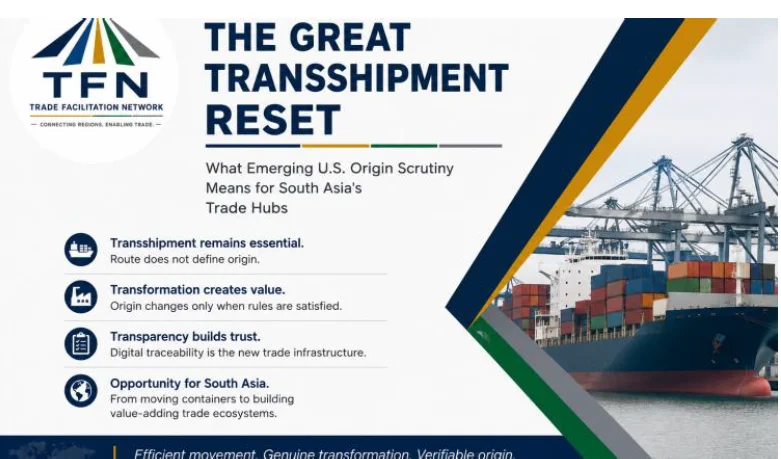
The Great Transshipment Reset should therefore encourage South Asian governments, ports and trade institutions to rethink what constitutes a competitive hub.
The objective should not be to copy one particular international model.
Colombo, Malaysia, Singapore, Dubai and emerging Indian hubs operate within different geographic and economic circumstances.
South Asia should develop arrangements suited to its own strengths.
But several principles can be common:
• Keep legitimate transshipment simple and fast.
• Provide legal frameworks for cross-stuffing, consolidation and multimodal transfers.
• Separate logistics operations clearly from origin-conferring manufacturing.
• Create pathways for genuine processing and value addition around trade hubs.
• Apply Rules of Origin transparently and consistently.
• Digitally preserve the identity and commercial history of cargo.
• Use risk management rather than unnecessary physical intervention.
And, importantly, design these systems with the requirements of major destination markets—including the United States—in mind.
The Great Transshipment Reset
The OTMP report should therefore be treated neither as an indictment of Asian transshipment nor merely as another chapter in the U.S.–China tariff dispute.
For South Asia, it is better understood as a caution about the direction in which international trade compliance is moving.
The movement of goods will remain global.
• Containers will continue changing vessels.
• Manufacturers will continue sourcing components from multiple countries.
• Regional hubs will become more—not less—important.
But the ability to distinguish movement from transformation and transformation from origin will become increasingly valuable.
Malaysia’s experience provides an important reference: strong maritime connectivity can coexist with manufacturing, value addition and increasingly sophisticated origin controls.
South Asia now has an opportunity to build the next generation of that model.
Its future trade hubs can combine:
Ports + Shipping Connectivity + Legal Transshipment + Cross-Stuffing + Multimodal Logistics + Manufacturing + Value Addition + Rules of Origin + Digital Traceability.
That is a much larger ambition than increasing TEU throughput.
It is about converting geography into economic activity while ensuring that goods destined for major international markets carry an origin that is legitimate, verifiable and trusted.
The Great Transshipment Reset should therefore not mean less trade facilitation.
It should mean better trade facilitation.
Trade Facilitation Network (TFN) Connecting Regions. Enabling Trade.